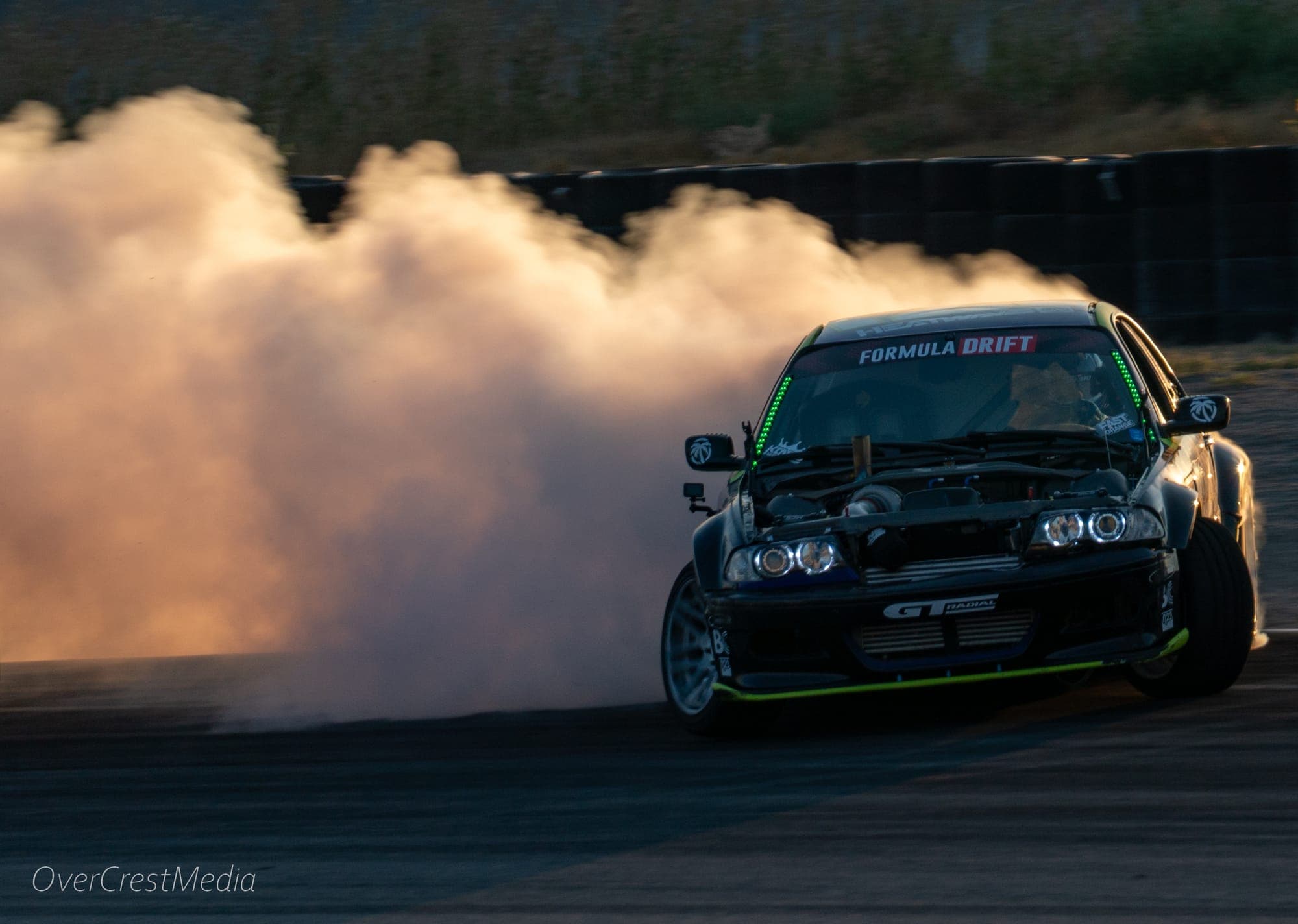
A slow shutter, a car moving sideways, and a wall of tire smoke. Notes on pulling sharp drivers out of soft chaos.
Formula Drift is the hardest thing I photograph, and it is not close. Everything that makes it thrilling to watch — the speed of entry, the proximity, the smoke — is actively working against a clean frame.
The car is moving fast, sideways, and unpredictably. The smoke that looks so good in person will happily swallow the subject whole. And the light is often flat and harsh at the events I shoot. So the whole game becomes subtraction: what do I remove to leave one sharp driver in a sea of motion?
The shutter is the whole thing
I settle around 1/320th for a drift entry and drop lower — 1/160th, sometimes 1/100th — once the car is settled into the skid and I can track it. Any faster and the smoke freezes into cotton wool and the sense of speed dies. Any slower and my hit rate falls off a cliff.
The trick is committing to the pan before the car arrives and following through long after the shutter fires, like a golf swing. You are not taking a photo of a moment. You are matching the camera's motion to the car's for a fraction of a second and hoping they line up.
Ten frames, one keeper. On a good day.
Smoke is a subject, not a problem
Once I stopped fighting the smoke and started composing with it, the work got better. Backlight it and it becomes a screen. Let it fill two thirds of the frame and put the car on the edge of it, half-revealed. The tandem battles are the best of all — a lead car vanishing into its own smoke with a chase car emerging from it, inches away.
It is chaos. That is the point. The job is to find the one clean line through it.